Supreme Thievery
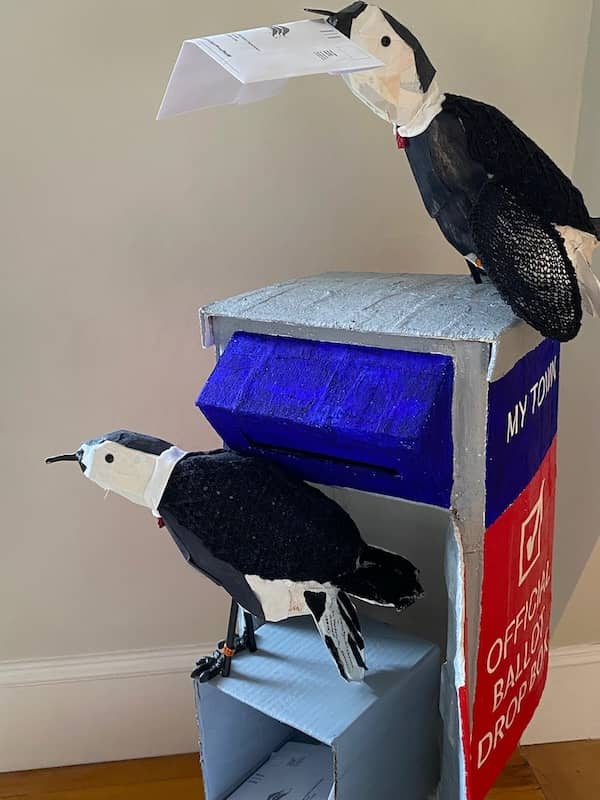
Supreme Thievery reflects my horror at the U.S. Supreme Court’s assault on the Voting Rights Act and the fairness and integrity of elections.
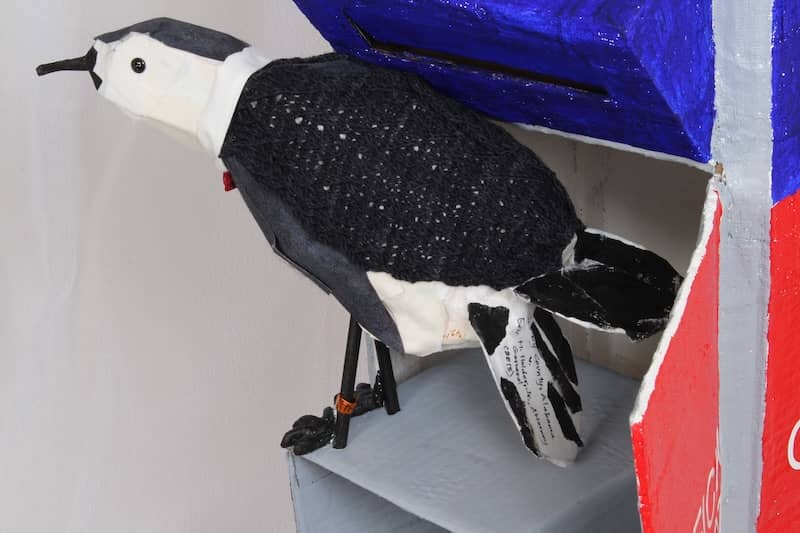
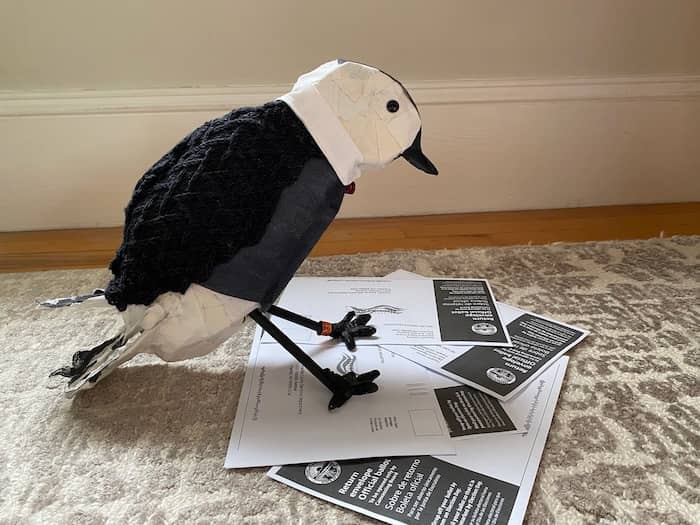
Wearing formal black robes with white shirt collars and red silk neckties, the birds are dressed as Supreme Court justices. Their stark black and white attire stands out against the patriotic red, white, and blue of the ballot box. The bird-justices are not sitting in court listening to legal arguments and issuing well-reasoned decisions. Rather, they have broken into that sacred container and overturned the storage bin, spilling the contents on the ground. One has with a ballot in his mouth as he gets ready to take flight.
This drama reflects what I see the Justices doing through their specious reasoning in a series of cases affecting elections. Leg bands identify the justices who authored some of the most damaging Supreme Court opinions, throwing out ballots of Native Americans who live on reservations in Arizona, refusing to count ballots of Latino and Black voters who accidentally voted in the wrong precinct, removing the legal protection of the Voting Rights Act that counter discriminatory practices, and giving states permission to reduce some votes to meaningless gestures through gerrymandering.
The setting for this work is a ballot drop box in my town, your town, or any town. In real life, voters may deposit absentee and vote-by-mail ballots in these secure containers. They make voting accessible in the days and weeks before Election Day and during hours when election and city clerks’ offices might be closed. A ballot drop box to expose the violation of voters’ rights in a tangible way.
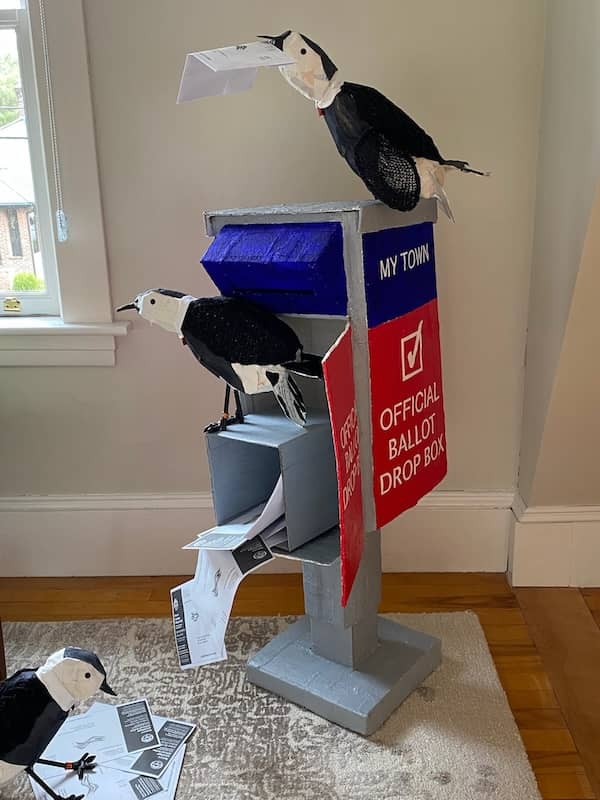
wool yarns, cotton cloth, mulberry paper, silk, printed envelopes, rigid foam, cardboard, plaster, clay, acrylic paint, vinyl lettering, wire, screws, copper foil
48 x 25 x 42 inches
Artwork and images ©2025 Eve Jacobs-Carnahan
Tucked into their tail feathers are the names of the cases:
Brnovich v. Democratic National Committee (2021) (majority opinion by Justice Samuel Alito);
Shelby County, Ala. v. Holder (2013) (concurring opinion by Justice Clarence Thomas);
Rucho v. Common Cause (2019) (majority opinion by Chief Justice John Roberts).
Learn more about the court cases here:
Brennan Center for Justice on the significance of the Brnovich decision and explanation of the case background.
League of Women Voters’ discussion of how Voting Rights Act pre-clearance protects voters from discrimination and why the Court decision in Shelby County v. Holder is so damaging.
Slate magazine jurisprudence reporter’s analysis of Court’s decision in Rucho v. Common Cause and why it fails to protect the First Amendment rights of regular people. The decision elicited a searing dissent from Justice Elena Kagan, which you can hear her read from the bench here.